
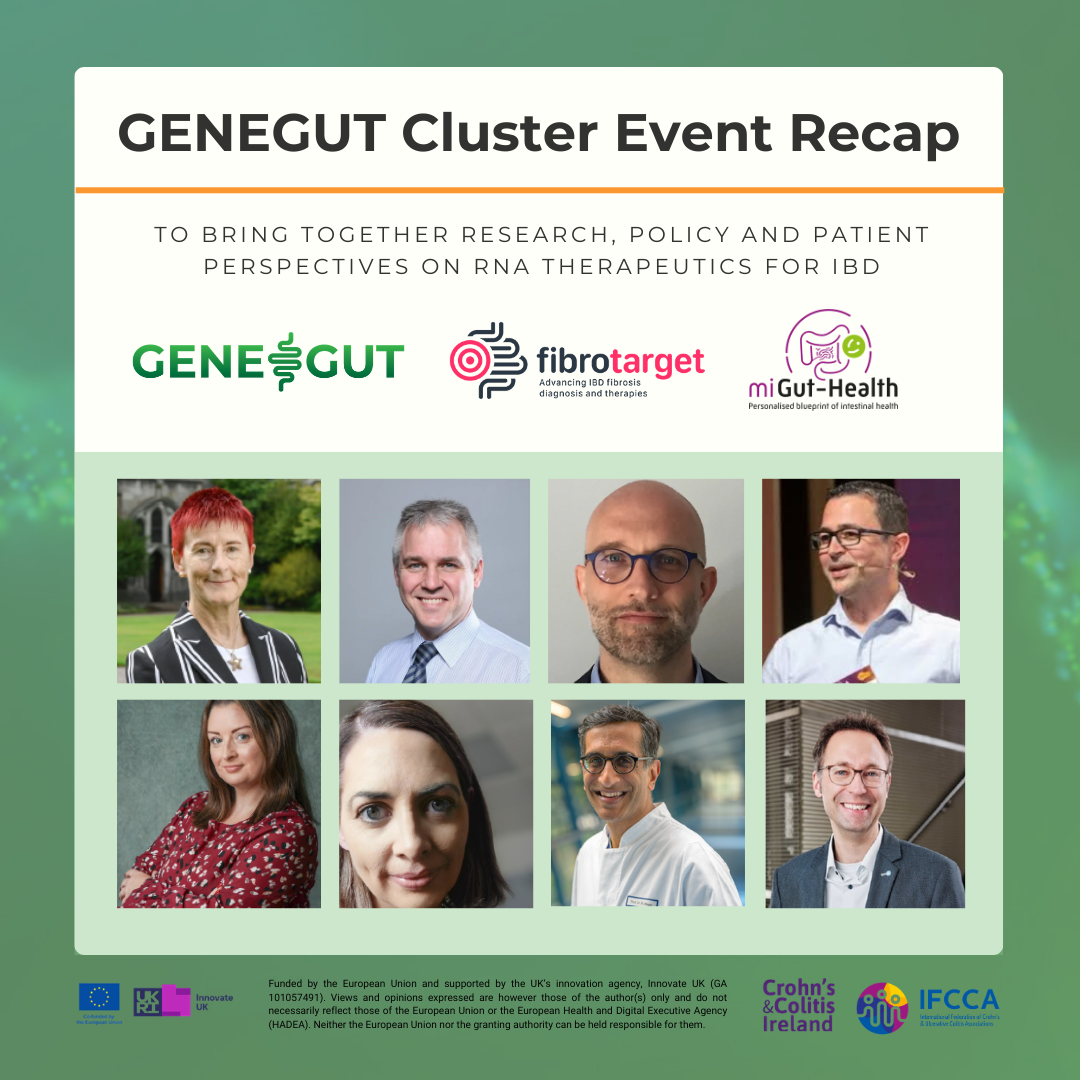
On 24 June 2026, the GENEGUT consortium hosted its online cluster event, “Advancing RNA Therapeutics for Inflammatory Bowel Disease”. The event brought together representatives from complementary EU-funded research projects, clinicians, patient organisations, regulatory expertise and health economics specialists to exchange knowledge on the scientific and translational challenges of developing RNA-based therapies for inflammatory bowel disease (IBD).
The event was opened by Caitriona O’Driscoll, GENEGUT Coordinator and Chair of Pharmaceutics at University College Cork, who introduced the aim of the cluster event: to connect research, policy and patient perspectives, foster exchange between related Horizon Europe projects and explore how EU-funded research can create greater impact for patients.
Introducing GENEGUT’s RNA-based approach to Crohn’s disease
Caitriona O’Driscoll presented the GENEGUT project and its work to develop a first-in-class oral RNA-based therapy for ileal Crohn’s disease. GENEGUT is working on an oral delivery system designed to transport RNA-loaded nanoparticles to the ileal region, where they can act locally in the intestinal tissue while aiming to avoid systemic side effects.
The presentation highlighted the project’s combination of novel biomaterials, advanced intestinal models, targeted capsule delivery, regulatory considerations, scale-up planning and health technology assessment. Together, these elements support GENEGUT’s ambition to progress towards a prototype oral delivery system for RNA therapeutics in Crohn’s disease.
Exchange with complementary EU-funded projects
The cluster event also provided an opportunity to hear from two related EU-funded projects working on complementary aspects of IBD research and therapeutic innovation.
Raja Atreya, Professor of Translational Immunology in Inflammatory Bowel Diseases and Head of the IBD Unit and Clinical Study Centre at University Hospital Erlangen, presented FIBROTARGET. His presentation focused on intestinal fibrosis in Crohn’s disease, the need for early biomarkers and improved diagnostic tools, and the project’s work towards targeted approaches that may help prevent or treat irreversible fibrotic damage.
Andre Franke, Professor of Molecular Medicine and Director of the Institute of Clinical Molecular Biology at Kiel University, presented miGut-Health. He introduced the project’s work on personalised strategies for gut health, early disease prediction and prevention, with a focus on large-scale omics, microbiome and immune profiling studies to better understand the molecular basis of IBD.
Research roundtable: advancing RNA therapeutics for IBD
The first roundtable, “Advancing RNA Therapeutics for IBD”, was moderated by Jens Ceulemans, Scientific Director at Johnson & Johnson Innovative Medicine. The discussion explored scientific and practical barriers to effective delivery of RNA therapeutics to inflamed intestinal tissue, as well as the requirements for clinical translation.
Speakers included Roberto Saldana, Innovation and Patient Engagement Coordinator at IFCCA, Orlaith Kelly, Consultant Gastroenterologist and Clinical Lead for Gastroenterology at Connolly Hospital, and a non-clinical assessor from MHRA.
The discussion highlighted that future RNA-based treatments will need to balance safety, effectiveness, durability, accessibility and patient burden. From a patient perspective, the priorities remain clear: reducing flares, avoiding surgery, minimising side effects and supporting a stable quality of life. The exchange also underlined that oral or self-administered treatments are attractive only if they are safe, effective and manageable in daily life.
Clinical and regulatory perspectives further emphasised the importance of relevant preclinical models, robust safety data, pharmacokinetic understanding, proof of concept and a clear assessment of whether RNA therapeutics remain local or distribute more widely in the body. The discussion also addressed the regulatory implications of novel biomaterials and the need to assess the safety of new delivery materials in a clinically relevant way.
Policy and impact perspective
The policy and impact session was led by Dyfrig Hughes, Professor of Health Economics at Bangor University. His contribution focused on the relevance of GENEGUT’s work for healthcare systems, the importance of health technology assessment and the need to consider equitable access to future innovation.
The session also included reflections on patient survey findings and the broader value of integrating health economics, policy perspectives and patient priorities early in the development of advanced therapies. This is particularly relevant for RNA-based treatments, where scientific promise must be accompanied by a clear understanding of affordability, access, implementation and real-world value.
Policy roundtable: translating research into policy action
The second roundtable, “Translating Research into Policy Action”, was moderated by Dyfrig Hughes. Speakers included Victoria Spillane, Patient Advocacy Representative at Crohn’s & Colitis Ireland, Roberto Saldana from IFCCA and the non-clinical assessor from MHRA.
The discussion focused on patient priorities, treatment expectations, benefit-risk considerations and policy mechanisms that may support access to RNA-based treatments. Participants stressed that future therapies should not only be scientifically innovative, but also acceptable, accessible and meaningful for people living with Crohn’s disease.
Building connections for future impact
The event demonstrated the value of bringing complementary perspectives together early in the translational pathway. By connecting GENEGUT’s RNA delivery research with fibrosis expertise, omics-based IBD research, clinical insight, patient experience, regulatory considerations and health economics, the cluster event helped identify shared challenges and opportunities for future collaboration.
For GENEGUT, the exchange provided valuable input for the next stages of the project. It reinforced the importance of developing RNA therapeutics that are not only scientifically promising, but also clinically relevant, safe, accessible and aligned with patient needs.
GENEGUT warmly thanks all speakers, invited experts and participants who contributed to the cluster event.
The consortium is particularly grateful to the representatives of FIBROTARGET and miGut-Health for sharing complementary project perspectives and to the patient representatives, clinical and regulatory contributors, IFCCA and CCI and GENEGUT partners who joined the roundtable discussions.
Also, we have prepared a virtual exhibition space for you to explore materials from GENEGUT, FIBROTARGET, Mi-GUT Health, IFCCA and CCI. Explore project posters and videos showcasing the latest developments in IBD research, RNA therapeutics and patient advocacy.
Click below to enter the exhibition and start exploring.